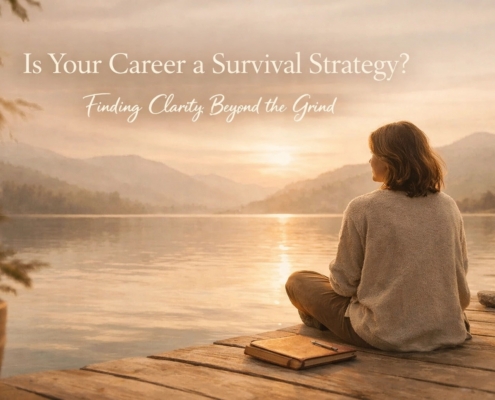

Is Your Career a Survival Strategy? Finding Clarity Beyond the Grind

We often think of our careers as a series of choices we made because we were talented, interested, or simply following the logical next step. But for many of us, if we peel back the layers of our professional drive, we find something far more primal than a passion for spreadsheets or project management. We find a survival strategy. When you feel that tightening in your chest on a Sunday evening or that deep, soul-level exhaustion that a long weekend can’t seem to touch, you aren’t just experiencing stress. You might be experiencing a nervous system that has been stuck in a survival state for years, using your career as a way to stay safe, relevant, or “enough” in a world that feels inherently precarious.
In my work as a therapist, I see so many high-achievers who are incredibly successful on paper but feel utterly hollow inside. They have the titles and the salaries, yet they are constantly scanning for threat, waiting for the other shoe to drop or for someone to realize they are a “fraud.” This isn’t just “imposter syndrome” in the way popular psychology likes to frame it. It is often a remnant of child- hood trauma or family dynamics where performance was the only currency for love or safety. When We look at individual therapy, we aren’t just looking at your current job duties; we are looking at the foundational architecture of your life and why you feel the need to grind until there is nothing left of you.
Consider the role you played in your family of origin. Perhaps you were the “responsible one” who had to keep the peace, or the “golden child” whose achievements were the only thing that made a depressed parent smile. If your early environment required you to perform to be seen, your career becomes the adult version of that performance. You aren’t just working for a paycheck; you are work- ing to maintain a sense of self that feels dangerously fragile without constant external validation. This is where career clarity coaching begins to overlap with deep, relational work. We have to understand who you are trying to appease when you stay at the office until 8:00 PM every night.

The “grind” is often a form of functional freeze or chronic sympathetic arousal. In the world of trauma and the nervous system, we talk about fight, flight, freeze, and fawn. Many corporate cultures are es- sentially built on a foundation of collective “fight” or “fawn” responses. You might find yourself com- pulsively over-working (fight) or constantly people-pleasing your boss and colleagues (fawn) just to feel a baseline level of security. Over time, this fry-cooks your nervous system. You lose the ability to distinguish between a tight deadline and a true life-or-death emergency. Your body reacts to a missed email with the same physiological intensity it would to a predator in the wild. This is why work-life balance coaching often fails if it only focuses on time management, it’s not a time problem; it’s a nervous system regulation problem.
Imagine a theoretical professional, let’s call him Alex. Alex is a senior executive who has spent fifteen years climbing the ladder. He is the first person in his family to go to college, and he carries the weight of his entire family’s upward mobility on his shoulders. For Alex, a bad quarter isn’t just a busi- ness setback; it feels like a personal moral failure that threatens his very right to exist. He is constantly “on,” checking his phone at dinner, unable to truly connect with his partner or children. He comes to me for online therapy because he is “burnt out,” but what we discover is that his career is a massive, complex survival strategy designed to ensure he never feels as vulnerable or “small” as he did as a child in a volatile household.
When we work together in this capacity, we use an approach called AEDP (Accelerated Experiential Dynamic Psychotherapy) to help you actually feel the cost of this survival strategy in your body. It isone thing to know intellectually that you work too hard. It is another thing entirely to sit with the grief of the “little you” who felt they had to be perfect to be safe. My practice is focused on relational depth therapy, which means we don’t just talk about the problem, we experience the shift in real- time. We look for those moments of “glimmers,” where you feel a sense of internal peace that isn’t dependent on your to-do list being finished.

Finding career clarity doesn’t always mean quitting your job and moving to a farm, though for some, a radical shift is exactly what’s needed. More often, it means changing the way you inhabit your career. It’s about moving from a reactive, survival-based posture to an intentional, value-based one. It’s about learning to set boundaries that feel terrifying at first but eventually become the walls of your sanctuary. When you understand the “why” behind your drive, you gain the power to choose when to push and when to rest. You start to see that you are more than your output, and your worth is not a variable that fluctuates with the stock market or your annual review.
I provide all of my sessions through a secure, online-only therapy platform, which allows you to en- gage in this deep work from the privacy and comfort of your own space. This is particularly beneficial for busy professionals who find the logistics of getting to a physical office just one more “to-do” on an already overflowing list. We can carve out a sacred hour where the focus is entirely on your inter- nal world, uninterrupted by the demands of the “grind.” If you want to learn more about how I work, you can read more about me and my philosophy on transformation and healing.
The transition from surviving to thriving requires a certain kind of bravery. It requires you to look at the parts of yourself you’ve kept hidden behind professional accolades and “busy-ness.” It asks you to consider: if I wasn’t constantly producing, who would I be? That question can feel like a void, but I promise you, it is actually a clearing. It is the space where your true self, the one that isn’t just a col- lection of survival strategies, can finally breathe. Whether we are addressing creating healthy relationships or navigating a massive professional pivot, the goal is always the same: to help you feel more alive, more grounded, and more “you.”

If you feel like you are white-knuckling your way through your professional life, please know that it doesn’t have to stay this way. You aren’t “weak” for feeling burnt out; you are likely just carrying a load that was never meant for one person to bear alone, especially if that load is tied to decades of old, unprocessed family expectations. We can look at how therapy helps move you out of that func- tional freeze and back into a state of flow. Career clarity isn’t just about finding the “right” job: it’s about finding the right way to be yourself in the world.
If you’re ready to stop just surviving and start exploring what it might feel like to actually thrive, I in- vite you to schedule a consultation. We can talk about where you are, where you feel stuck, and how we can work together to build a life that feels as good on the inside as it might look on the outside. You’ve spent long enough taking care of everyone else’s expectations; it’s time to start taking care of your own soul. The grind will always be there, but you don’t have to be consumed by it. Let’s find a different way forward, together.