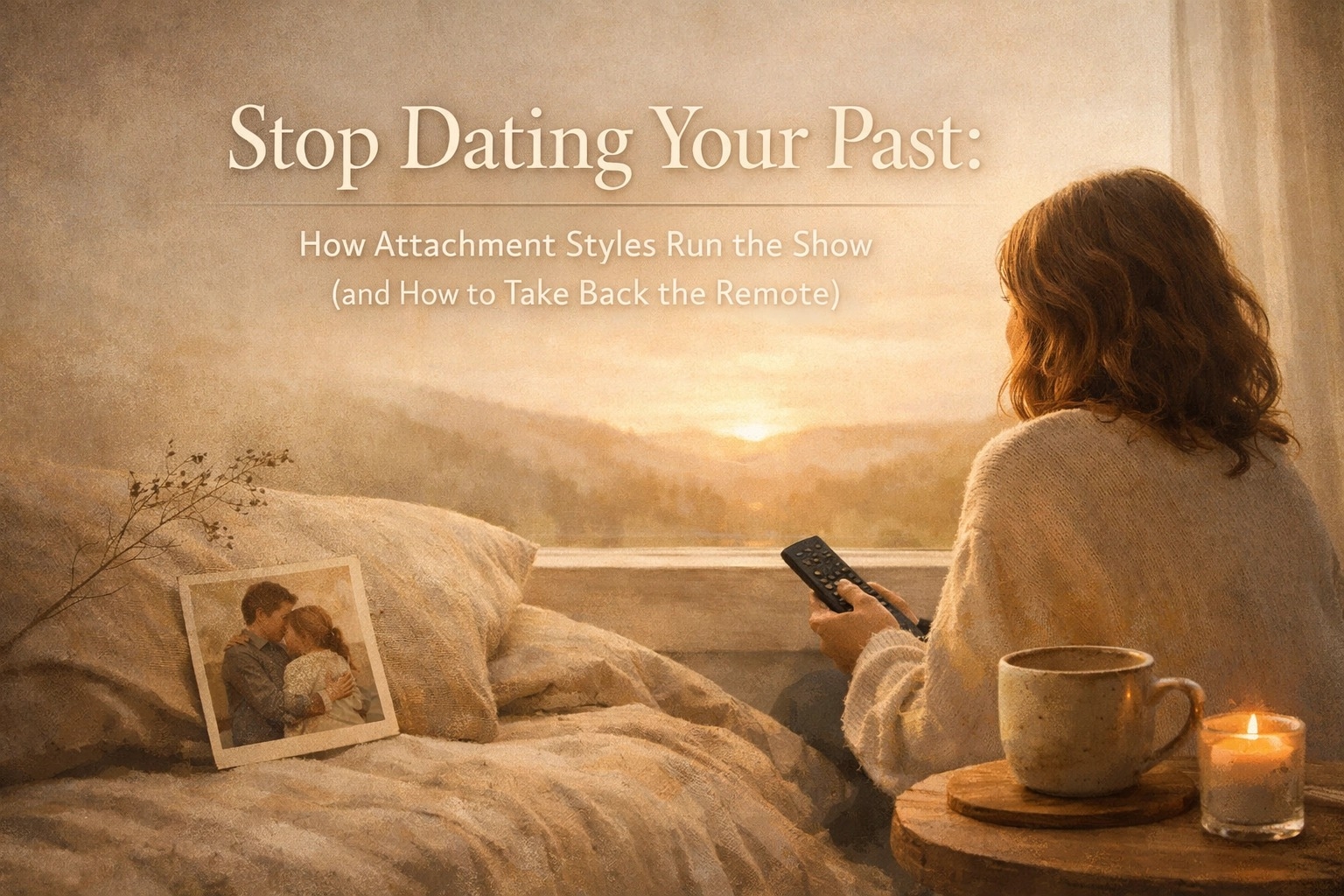
Stop Dating Your Past: How Attachment Styles Run the Show (and How to Take Back the Re-mote)
Have you ever felt like you are starring in a movie you have already seen: one where the ending al-ways involves a slammed door, a cold silence, or that familiar, hollow ache in your chest? It is deeply frustrating to realize that while the faces of our partners change, the script remains stubbornly the same. This is the weight of our attachment styles in relationships. It is the invisible hand that steers us toward the same types of people and the same types of heartache. But here is the thing: your past is not a life sentence. It is more like a remote control that has been stuck on one channel for too long. My work is about helping you find that remote, understanding why it was programmed that way, and finally learning how to change the station.
When we talk about attachment styles, we are really talking about the blueprints for love that we were handed before we could even speak. These patterns are formed in the crucible of our earliest re-lationships with our caregivers. If you grew up in an environment where your needs were met with consistency and warmth, you likely developed a secure attachment style. You feel comfortable with intimacy and do not spend your days compulsively scanning for threat. But for many of us, those ear-ly blueprints were a bit more chaotic. Perhaps love felt conditional, or maybe it felt like it could vanish at any moment. Those experiences create the internal working models that we carry into our adult lives, often without ever realizing they are there.
In my practice, I see how these styles manifest in the modern world of dating and long-term partner-ship. Whether we are navigating individual therapy or exploring the nuances of creating healthy rela-tionships , the goal is to bring these unconscious scripts into the light. Because once you see the pat-tern, you have the power to interrupt it. My approach is rooted in AEDP (Accelerated Experiential Dy-namic Psychotherapy), which means we do not just talk about your past: we feel into how it is show-
ing up in your body and your heart right now. We work together to transform those old, limiting scripts into something that feels more aligned with who you are today.

Consider a theoretical example of what this looks like in practice. Let’s imagine a person: we will call her Elena: who constantly finds herself attracted to partners who are emotionally unavailable. On pa-per, Elena is successful, compassionate, and deeply self-aware. Yet, in her romantic life, she is stuck in a loop. She meets someone who seems exciting but distant, and her “anxious part” immediately takes the wheel. This part of her is hyper-focused on every text message, every shift in tone, and every minute of silence. She feels like she is fighting for the relationship, but in reality, she is fighting for a sense of safety that she never quite felt as a child.
On the other side of this dynamic, we might see someone like Marcus. Marcus is a theoretical person who prides himself on his independence. He values his space and often feels “suffocated” when a partner wants to get close. His “avoidant part” is a master at building walls. When things get too inti-mate, he finds reasons to pull away: focusing on his partner’s flaws or staying late at the office. To Marcus, closeness feels like a threat to his autonomy. Both Elena and Marcus are operating from parts of themselves that were formed to protect them, but those very protections are now the things keep-ing them lonely. This is the core of my practice: untangling these protective parts so you can actually connect with the person sitting across from you.
The “Anxious-Avoidant Dance” is perhaps the most common cycle I see in online therapy. It is a per-fect storm where one person’s fear of abandonment triggers the other person’s fear of engulfment. The more Elena pursues, the more Marcus retreats. The more Marcus retreats, the more frantic Elena becomes. It is exhausting, and it often leads to a “Why am I so mad?” moment. This brings us to the
concept of parts work. When we are triggered in a relationship, it is rarely our “adult self” doing the talking. It is usually a younger part of us that is reacting to an old wound. Anger, in this context, is of-ten a bodyguard. It shows up to protect a more vulnerable part of us that feels small, rejected, or un-heard.
I often remind my clients that their nervous system isn’t broken: it is protective. If you find yourself exploding in anger over a small disagreement, or if you feel a surge of rage when a partner doesn’t reply to a text, that anger is giving us important information. It might be saying, “I will not be ignored again,” or “It isn’t safe to be this vulnerable.” In our sessions, which I conduct exclusively online for your comfort and privacy, we look at these “parts” with curiosity rather than judgment. We ask the anger what it is trying to protect. By doing this, we move from being “run” by our attachment styles to being the “leader” of our internal world.

Choosing to dive into this work is a significant investment in yourself. My fee of $250 per session re-flects the specialized training I bring to the table: combining AEDP, parts work, and a deep under-standing of relational trauma to create lasting change. We are not just puting a bandage on the problem; we are rewiring the way you experience connection. This level of depth requires a commit-ment to looking at the hard stuff, but it also offers the possibility of a kind of freedom you might not have thought possible. You can learn more about me and my philosophy to see if this feels like the right fit for your journey.
One of the most powerful tools we have in this process is the “dependency paradox.” It is a concept that suggests we are only as independent as we are securely attached. When we have a “secure base”: a partner we can truly rely on: we actually become more courageous and independent in the world.
But to get to that secure base, we have to deal with the parts of us that are afraid of leaning on someone. We have to address the “disorganized parts” that want closeness but also fear it. This is where the therapeutic relationship becomes a laboratory for change. Through online therapy, we cre-ate a safe space where you can practice being seen and supported in real-time.
Take a moment to think about your own “internal remote control.” What channel is it stuck on? Is it the channel of “I have to do everything myself because no one else will”? Or is it “I’m not enough, so I have to keep proving my worth”? Whatever the script, know that it was written a long time ago by someone who was just trying to survive. You don’t have to be mad at those parts of yourself. In fact, we can thank them for getting you this far. But you can also tell them that you are the adult now, and you are ready to take over the controls.

Healing your attachment style is not about becoming a different person; it is about returning to the person you were always meant to be before the world told you that love was dangerous or scarce. It is about developing the emotional intelligence to recognize when a “part” has taken over and having the tools to bring yourself back to center. When you work with me, we focus on these shifts as they happen. We celebrate the moments when you choose a different response: when you stay present in-stead of running, or when you ask for what you need instead of waiting for someone to fail you.
The beauty of focusing on creating healthy relationships is that the work ripples out into every area of your life. When you feel more secure in your romantic life, you often find more clarity in your career and more peace in your friendships. You stop wasting energy on the “dating your past” loop and start investing that energy into building a life that feels authentic and vibrant. This is the transformation that individual therapy can offer. It is a path toward being more decisive, creative, and intuitively alive.
If you are tired of the same old reruns and are ready to start a new chapter, I am here to help. We can untangle the threads of your past together, right from the comfort of your own space. The process of taking back the remote starts with a single step: a realization that you deserve a connection that doesn’t require you to shrink or stay on guard. I invite you to explore my practice and see how we can work together to rewrite your story. The past might have written the first few chapters, but you get to write the ending. Reach out when you’re ready to start.